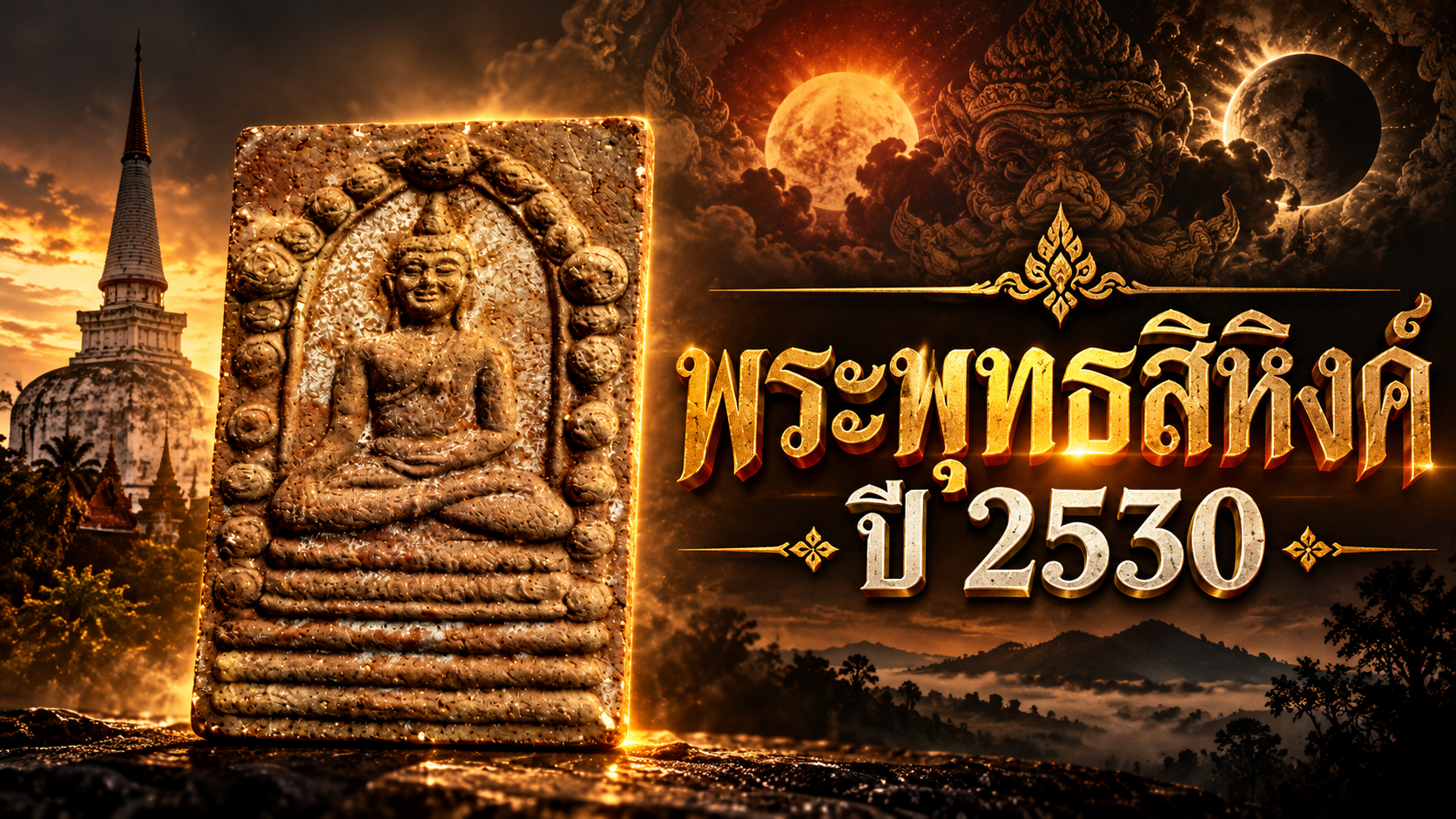
พระพุทธสิหิงค์ ปี 2530
พุทธปฏิมาคู่ “สุริยัน–จันทรา” แห่งวาระกำเนิดหลักเมืองนครศรีธรรมราช
ในประวัติศาสตร์วัตถุมงคลของนครศรีธรรมราช ปี พ.ศ. 2530 คือปีหนึ่งที่มีความหมายอย่างยิ่ง เป็นช่วงเวลาที่การก่อสร้าง ศาลหลักเมืองนครศรีธรรมราช กำลังดำเนินไปพร้อมกับการก่อรูปของชุดความเชื่อ เรื่องเล่า พิธีกรรม และสัญลักษณ์ต่าง ๆ ซึ่งหลายปีต่อมาจะกลายเป็นรากฐานสำคัญของสิ่งที่คนไทยทั่วประเทศรู้จักในชื่อ “จตุคามรามเทพ” หากกล่าวถึงวัตถุมงคลจากยุคนั้น สิ่งที่นักสะสมส่วนใหญ่นึกถึงก่อนมักเป็น พระผงสุริยัน–จันทรา ปี 2530 หรือ “แว่นกลม” ซึ่งภายหลังกลายเป็นหนึ่งในวัตถุมงคลต้นสายที่มีชื่อเสียงที่สุดของจตุคามรามเทพ แต่ในวาระเดียวกัน ยังมีพระเนื้อผงรูปสี่เหลี่ยมองค์หนึ่งถือกำเนิดขึ้นเคียงคู่กัน นั่นคือ “พระพุทธสิหิงค์ รุ่นหลักเมืองนครศรีธรรมราช ปี 2530” พระองค์เล็ก ๆ ที่ครั้งหนึ่งอาจได้รับความสนใจมากกว่าสุริยัน–จันทราเสียด้วยซ้ำ และเป็นพระที่มีความสัมพันธ์กับประวัติศาสตร์การสร้างหลักเมืองอย่างแนบแน่น ตั้งแต่รูปแบบ มวลสาร ไปจนถึงพิธีกรรม
พระพุทธสิหิงค์ : พระพุทธรูปคู่เมืองนครศรีธรรมราช
การที่คณะผู้สร้างเลือกนำ พระพุทธสิหิงค์ มาเป็นต้นแบบ มิใช่เรื่องบังเอิญ พระพุทธสิหิงค์เป็นพระพุทธรูปสำคัญที่มีความผูกพันกับประวัติศาสตร์นครศรีธรรมราชมาอย่างยาวนาน เป็นทั้งพระพุทธปฏิมาที่ประชาชนเคารพนับถือและเป็นส่วนหนึ่งของอัตลักษณ์ทางศาสนาของเมือง ดังนั้น ในช่วงเวลาที่กำลังสร้าง “หลักเมือง” เพื่อเป็นศูนย์รวมเชิงสัญลักษณ์ของนคร การจำลองพระพุทธสิหิงค์ออกมาเป็นพระเครื่องจึงเท่ากับนำสัญลักษณ์ทางพระพุทธศาสนาที่คนเมืองคุ้นเคยเข้ามาอยู่ในโครงการเดียวกัน แหล่งข้อมูลในสายวัตถุมงคลระบุว่า พล.ต.ท. สรรเพชญ ธรรมาธิกุล เป็นผู้ออกแบบรูปแบบของพระ ส่วน อาจารย์มนตรี จันทพันธ์ เป็นผู้แกะแม่พิมพ์ ซึ่งเป็นบุคคลที่เกี่ยวข้องกับงานวัตถุมงคลหลักเมืองนครศรีธรรมราชในยุคนั้นด้วย
รูปแบบพระ : พุทธศิลป์ด้านหน้า จักรวาลด้านหลัง
พระพุทธสิหิงค์ ปี 2530 เป็นพระเนื้อผงรูปทรงสี่เหลี่ยมผืนผ้า ลักษณะที่คนในวงการเรียกกันว่า “ทรงชิ้นฟัก” ตรงกลางเป็นพระพุทธสิหิงค์ประทับนั่ง ปางมารวิชัย บนฐานบัว ด้านบนและด้านข้างล้อมด้วยซุ้มที่มีลวดลายคล้ายก้นหอยหรือ “สะดือทะเล” มีการบันทึกว่าซุ้มประกอบด้วยลวดลายก้นหอยน้อยใหญ่รวมประมาณ 21 วง และด้านล่างรองรับด้วยฐานหน้ากระดานสามชั้น หากมองเพียงด้านหน้า พระองค์นี้ก็ดูเป็นพระพุทธปฏิมาตามคติพุทธศาสนา แต่เมื่อพลิกด้านหลัง เรื่องราวกลับเปลี่ยนไปทันที เพราะด้านหลังปรากฏรูป พระราหูอมสุริยัน–จันทรา และใต้ภาพราหูยังปรากฏเครื่องหมายยันต์ซึ่งแหล่งข้อมูลสายวัตถุมงคลอธิบายว่าเกี่ยวข้องกับหัวใจธรณี หัวใจมนุษย์ และคาถากำกับธาตุ องค์ประกอบนี้เองที่ทำให้พระพุทธสิหิงค์ ปี 2530 มีความเชื่อมโยงโดยตรงกับโลกสัญลักษณ์ของพระผงสุริยัน–จันทรา จึงอาจมองเชิงสัญลักษณ์ได้ว่า
ด้านหน้าคือ “พุทธะ”
ด้านหลังคือ “จักรวาล”
ด้านหน้า พระพุทธองค์ประทับอย่างสงบนิ่ง
ด้านหลัง สุริยัน จันทรา ราหู ธาตุ และสัญลักษณ์จักรวาลดำรงอยู่พร้อมกัน
พระองค์เดียวจึงรวมโลกความคิดสองชุดของนครศรีธรรมราชเอาไว้ในชิ้นงานเดียวอย่างน่าสนใจ
สร้างพร้อมพระผงสุริยัน–จันทรา ปี 2530
สิ่งสำคัญที่สุดประการหนึ่งคือ พระพุทธสิหิงค์ไม่ได้เกิดขึ้นในยุคหลังจตุคามโด่งดัง แต่สร้างขึ้น ตั้งแต่ยุคต้นของโครงการศาลหลักเมืองนครศรีธรรมราช และมีข้อมูลหลายแหล่งตรงกันว่า สร้างขึ้นในวาระเดียวกับพระผงสุริยัน–จันทรา ปี 2530 ใช้มวลสารหลักในชุดเดียวกัน และเกี่ยวข้องกับพิธีกรรมชุดเดียวกัน ข้อมูลในวงการพระระบุด้วยว่า พระพุทธสิหิงค์เกี่ยวข้องกับพิธีเบิกเนตรหลักเมืองระหว่างวันที่ 3–5 มีนาคม พ.ศ. 2530 จุดนี้มีความหมายมาก เพราะทำให้พระพุทธสิหิงค์มิใช่เพียงพระที่ “เกี่ยวกับจตุคาม” ในภายหลัง แต่เป็นวัตถุร่วมสมัยที่อยู่ในเหตุการณ์เดียวกับต้นกำเนิดของพระผงสุริยัน–จันทราเอง
มวลสาร : หัวใจของพระพุทธสิหิงค์ ปี 2530
ความน่าสนใจของพระพุทธสิหิงค์รุ่นนี้ไม่ได้อยู่ที่แม่พิมพ์เพียงอย่างเดียว แต่ยังอยู่ที่ มวลสาร เพราะข้อมูลที่เผยแพร่ในสายวัตถุมงคลหลายแหล่งระบุสอดคล้องกันว่า พระพุทธสิหิงค์เป็นพระเนื้อผงซึ่งใช้ มวลสารหลักชนิดเดียวกับพระผงสุริยัน–จันทรา ปี 2530
มวลสารที่มีการบันทึกไว้ประกอบด้วย
ไม้ตะเคียนทองหลักเมือง
ปูนเปลือกหอย
ปูนหิน
ดินจากสังเวชนียสถาน 4 แห่ง
ดิน 7 ป่าช้า
แร่ 7 เหมือง
ข้าวสุก 7 นา
ผงกะลาตาเดียว
เกสรดอกไม้ 108 ชนิด
ว่านมงคล 108 ชนิด
น้ำตาลอ้อย
น้ำผึ้งหลวง
กล้วย
เกลือ
อับเพชร
น้ำศักดิ์สิทธิ์ 4 บ่อ
ผงอิทธิเจ
น้ำมันจันทน์
เงิน
ทอง
และนาก
รายการดังกล่าวควรอ่านอย่างมีวิจารณญาณ เพราะส่วนใหญ่ถูกถ่ายทอดผ่านบันทึกและแหล่งข้อมูลในวงการพระเครื่อง ไม่ใช่ผลการตรวจวิเคราะห์องค์ประกอบทางวิทยาศาสตร์ของพระทุกองค์ แต่ในเชิงประวัติศาสตร์ความเชื่อ รายการมวลสารนี้มีความน่าสนใจอย่างยิ่ง เพราะมันแสดงให้เห็นแนวคิดของผู้สร้างว่า ต้องการรวบรวม “ธาตุ” และวัสดุจากหลายโลกเข้าไว้ด้วยกัน
ไม้ตะเคียนทอง — สายสัมพันธ์โดยตรงกับหลักเมือง
ในบรรดามวลสารทั้งหมด สิ่งที่มีความหมายที่สุดในเชิงประวัติศาสตร์น่าจะเป็น ไม้ตะเคียนทองหลักเมือง เพราะไม้ตะเคียนมีความสัมพันธ์โดยตรงกับเสาหลักเมืองและพิธีกรรมการสร้างหลักเมืองนครศรีธรรมราช พระบางองค์โดยเฉพาะกลุ่มเนื้อดำ มีการอธิบายในวงการสะสมว่าใช้ ผงถ่านไม้ตะเคียน เป็นส่วนประกอบสำคัญ โดยนำไม้ตะเคียนมาเผาเป็นถ่านแล้วบดผสมลงในเนื้อพระ นี่ทำให้เกิดเนื้อพระหลายลักษณะ ทั้งดำสนิท, ดำเทา, ดำอมน้ำตาล และเนื้อที่เห็นเส้นใยหรือองค์ประกอบคล้ายเนื้อไม้ พระอีกกลุ่มหนึ่งมีสีขาว ขาวอมส้ม หรือขาวอมเขียว ซึ่งข้อมูลในตลาดพระอธิบายว่าเกิดจากสัดส่วนของส่วนผสมและเนื้อปูนที่แตกต่างกัน ถ้ามองในเชิงสัญลักษณ์ การนำไม้ที่มีความสัมพันธ์กับหลักเมืองเข้ามาผสมในองค์พระ เท่ากับทำให้พระพุทธสิหิงค์ไม่ใช่เพียง “ของที่ระลึกจากการสร้างหลักเมือง” แต่มีวัสดุที่เชื่อมโยงกับโครงการหลักเมืองอยู่ภายในเนื้อพระด้วย
ดิน 7 ป่าช้า แร่ 7 เหมือง ข้าว 7 นา
มวลสารอีกชุดหนึ่งที่สะท้อนโลกความคิดแบบโบราณได้อย่างชัดเจนคือ
ดิน 7 ป่าช้า
แร่ 7 เหมือง
ข้าวสุก 7 นา
ในบริบทพิธีกรรม เลข “7” ถูกใช้ในวัฒนธรรมพื้นบ้านไทยอยู่บ่อยครั้งเพื่อสื่อถึงการรวบรวมจากหลายสถานที่หรือหลายภูมิ
ดิน คือพื้นพิภพ
แร่ คือทรัพย์ที่ซ่อนอยู่ใต้พื้นดิน
ข้าว คือความอุดมสมบูรณ์และการดำรงชีวิตของผู้คน
เมื่อสามสิ่งนี้ถูกนำมารวมอยู่ในเนื้อพระ จึงเสมือนเป็นการจำลอง “โลกของแผ่นดิน” เข้าไว้ภายในวัตถุชิ้นเล็ก
เกสร 108 และว่าน 108
รายการมวลสารยังกล่าวถึง
เกสรดอกไม้ 108 ชนิด
และว่านมงคล 108 ชนิด
เลข 108 มีสถานะพิเศษในวัฒนธรรมทางศาสนาและพิธีกรรมของเอเชีย และถูกใช้ในบริบทที่สื่อถึงความครบถ้วนสมบูรณ์มาอย่างยาวนาน ในบริบทของการสร้างพระเครื่อง การระบุ “108” จึงไม่เพียงหมายถึงปริมาณของพืช แต่ยังเป็นภาษาทางพิธีกรรมที่บอกถึงความตั้งใจรวบรวมสิ่งมงคลให้ครบถ้วนตามคติของผู้สร้าง
น้ำศักดิ์สิทธิ์ ผงอิทธิเจ และน้ำมันจันทน์
อีกกลุ่มหนึ่งคือมวลสารที่เกี่ยวข้องกับกระบวนการทางพิธีกรรม ได้แก่
น้ำศักดิ์สิทธิ์ 4 บ่อ
ผงอิทธิเจ
และน้ำมันจันทน์
ผงอิทธิเจสัมพันธ์กับวิชาเขียนและลบอักขระตามคติไสยเวทไทย ส่วนจันทน์ถูกใช้ในพิธีกรรมทางศาสนาและวัฒนธรรมไทยมายาวนาน วัสดุกลุ่มนี้จึงไม่ใช่เพียง “วัตถุ” แต่มีสถานะเป็นส่วนหนึ่งของกระบวนการประกอบพิธีตามความเชื่อของผู้สร้าง
เงิน ทอง นาก
สิ่งที่น่าสนใจอีกประการคือ รายชื่อมวลสารยังมี เงิน ทอง และนาก โลหะสามชนิดนี้ถูกใช้ในศิลปกรรมและวัตถุมงคลชั้นสูงของไทยมานาน อย่างไรก็ตาม ต้องเข้าใจให้ถูกต้องว่า พระพุทธสิหิงค์ ปี 2530 เป็น พระเนื้อผง ดังนั้น คำว่าเงิน ทอง และนากในที่นี้ควรเข้าใจว่าเป็นวัสดุที่มีการกล่าวถึงว่าอยู่ในชุดมวลสารหรือกระบวนการสร้าง มิได้หมายความว่าองค์พระเป็นพระเนื้อโลหะ
พิธี “สามภูมิ” — ทะเล ภูเขา และทุ่งนา
หนึ่งในเรื่องที่ถูกเล่าขานมากที่สุดเกี่ยวกับวัตถุมงคลชุดปี 2530 คือพิธีปลุกเสกมวลสารในสถานที่ที่แตกต่างกัน แหล่งข้อมูลสายพระเครื่องระบุว่า มีการนำมวลสารไปประกอบพิธีใน 3 ภูมิ ได้แก่
กลางทะเลลึก
บนภูเขาขุนพนม
และกลางทุ่งนา
ภายใต้ภาษาความเชื่อ มีการอธิบายพิธีนี้ในฐานะการเชื่อม
พื้นน้ำ
พื้นดิน
และนภากาศ
เข้าด้วยกัน และมีการกล่าวถึงการอาราธนาพระอาจารย์ในสาย วัดเขาอ้อ มาร่วมสาธยายมนต์ตามคติพิธีกรรมของภาคใต้ ส่วนนี้ต้องแยกให้ชัดว่าเป็น ข้อมูลตามประวัติและคำบอกเล่าของสายวัตถุมงคล ไม่ใช่สิ่งที่ควรอธิบายในลักษณะว่าพิธีดังกล่าวสร้าง “พลังทางฟิสิกส์” ให้กับองค์พระ แต่ในฐานะหลักฐานทางวัฒนธรรม พิธีสามภูมิน่าสนใจมากเพราะมันสะท้อนแนวคิดว่า วัตถุมงคลชิ้นหนึ่งไม่ได้เกิดจากวัสดุเพียงอย่างเดียว แต่ถูกทำให้มีความหมายผ่าน “สถานที่” และ “พิธีกรรม”
แม่พิมพ์จำนวนมากในพระรุ่นเดียว
อีกสิ่งหนึ่งที่ทำให้พระพุทธสิหิงค์ ปี 2530 เป็นพระที่ศึกษาได้สนุกคือ แม่พิมพ์มีหลายบล็อก เพราะผลิตในจำนวนมาก จึงต้องใช้แม่พิมพ์หลายชุด ส่งผลให้รายละเอียดแตกต่างกันในจุดเล็ก ๆ แม้โดยภาพรวมจะยังเป็นพระทรงเดียวกัน ส่วนพระเกศมักถูกแบ่งในวงการสะสมเป็นลักษณะต่าง ๆ เช่น
เกศบัวตูม
เกศแหลม
และเกศยาวหรือเกศชนซุ้ม
รายละเอียดองค์พระบางบล็อกพบเม็ดพระถัน บางบล็อกไม่พบ ด้านหลังเองก็มีราหูอย่างน้อยสองลักษณะใหญ่ คือ
ราหูทรงเครื่อง
และ
ราหูแบบธรรมดา
การจำแนกเช่นนี้จึงต้องพิจารณาหลายองค์ประกอบร่วมกัน ไม่ควรใช้รายละเอียดใดรายละเอียดหนึ่งตัดสินความแท้โดยลำพัง
วันที่พระผงสุริยัน–จันทรายังไม่ใช่พระดัง
ถ้าเราย้อนเวลากลับไปในปี 2530 แล้วถามประชาชนว่า ระหว่างพระพุทธสิหิงค์กับพระผงรูปกลมที่เต็มไปด้วยราหู จักรราศี และสัญลักษณ์แปลกตา พวกเขาจะเลือกอะไร คำตอบในเวลานั้นอาจไม่เหมือนวันนี้ พระพุทธสิหิงค์เป็นพระพุทธรูปที่คนรู้จัก ขณะที่สุริยัน–จันทรายังเป็นวัตถุมงคลใหม่ ซึ่งความหมายและเรื่องราวยังไม่ได้ถูกเผยแพร่กว้างขวาง กระทั่งหลังจากนั้นหลายปี โดยเฉพาะช่วงปลายทศวรรษ 2530 ต่อเนื่องเข้าสู่ทศวรรษ 2540 กระแสของสุริยัน–จันทราและชื่อจตุคามรามเทพจึงค่อย ๆ เติบโต ก่อนจะระเบิดเป็นปรากฏการณ์ระดับประเทศในช่วงประมาณ พ.ศ. 2549–2550 เมื่อถึงจุดนั้น บทบาทกลับกัน วัตถุมงคลสุริยัน–จันทรากลายเป็นของที่ผู้คนตามหาอย่างมาก ส่วนพระพุทธสิหิงค์ที่เกิดพร้อมกัน กลับค่อย ๆ อยู่ในเงาของชื่อ “จตุคามรามเทพ”
พระที่ถูกลืม หรือหลักฐานที่เรามองข้าม
ถ้าวัดคุณค่าจากกระแสตลาดเพียงอย่างเดียว พระพุทธสิหิงค์อาจดูเหมือนเป็นวัตถุมงคลรองจากสุริยัน–จันทรา แต่หากพิจารณาในเชิงประวัติศาสตร์ ภาพกลับต่างออกไปอย่างสิ้นเชิง พระองค์นี้ เกิดในวาระสร้างหลักเมือง สร้างในยุคเดียวกับสุริยัน–จันทรา ใช้มวลสารหลักในชุดเดียวกัน ใช้สัญลักษณ์ราหู สุริยัน และจันทราที่ด้านหลัง และมีประวัติพิธีกรรมซ้อนทับอยู่ในโครงการเดียวกัน พูดอีกอย่างหนึ่งคือ หากต้องการศึกษาว่า “จตุคามรามเทพยุคต้นเกิดขึ้นมาได้อย่างไร” การศึกษาพระผงสุริยัน–จันทราเพียงอย่างเดียวยังไม่ครบ เราต้องศึกษาพระพุทธสิหิงค์ด้วย
พุทธะและจักรวาลในองค์เดียว
สิ่งที่น่าสนใจที่สุดของพระพุทธสิหิงค์ ปี 2530 อาจไม่ใช่จำนวนสร้าง ไม่ใช่พิมพ์นิยม และไม่ใช่ราคาตลาด แต่อาจเป็น ภาษาของภาพ ด้านหนึ่งเป็นพระพุทธสิหิงค์ อีกด้านหนึ่งเป็นราหูอมสุริยัน–จันทรา พระพุทธองค์เป็นตัวแทนของธรรม สุริยันและจันทราเป็นตัวแทนของจักรวาล ราหูเป็นส่วนหนึ่งของคติเรื่องฟ้าและดวงดาว มวลสารมาจากดิน น้ำ พืช แร่ และวัสดุพิธีกรรม ทั้งหมดถูกนำมารวมกันในพระองค์เดียว สิ่งนี้ทำให้พระพุทธสิหิงค์ ปี 2530 เป็นตัวอย่างที่น่าสนใจมากของโลกทัศน์ภาคใต้ ซึ่งพระพุทธศาสนา ความเชื่อดั้งเดิม โหราศาสตร์ พิธีกรรม และความทรงจำของเมืองสามารถอยู่ร่วมกันได้โดยไม่จำเป็นต้องแยกเป็นคนละโลก
มากกว่าพระเครื่อง คือบันทึกของปี 2530
ผ่านมากว่าเกือบสี่ทศวรรษ สิ่งที่ทำให้พระพุทธสิหิงค์ ปี 2530 ยังน่าศึกษา ไม่ใช่เพียงเพราะเป็นของเก่า แต่เพราะองค์พระทำหน้าที่เสมือน แคปซูลเวลา ไม้ตะเคียน บอกเรื่องหลักเมือง ดิน บอกเรื่องแผ่นดิน ข้าว บอกเรื่องวิถีชีวิต ว่านและเกสร บอกเรื่องภูมิปัญญาพื้นบ้าน น้ำศักดิ์สิทธิ์และผงอิทธิเจ บอกเรื่องพิธีกรรม ราหู สุริยัน และจันทรา บอกเรื่องคติจักรวาล ส่วนพระพุทธสิหิงค์ที่ประทับอยู่ด้านหน้า เตือนเราว่าใจกลางของวัตถุมงคลชิ้นนี้ยังคงเป็น “พระพุทธปฏิมา” เมื่อองค์ประกอบทั้งหมดถูกรวมเข้าด้วยกัน พระพุทธสิหิงค์ ปี 2530 จึงเป็นมากกว่าวัตถุสำหรับคล้องคอ มันคือหลักฐานของช่วงเวลาหนึ่ง ช่วงเวลาที่เรื่องราวของหลักเมืองนครศรีธรรมราชกำลังถือกำเนิด ช่วงเวลาที่สุริยัน–จันทรายังมิได้กลายเป็นตำนาน และช่วงเวลาที่คำว่า “จตุคามรามเทพ” ยังไม่ใช่ชื่อที่คนทั้งประเทศรู้จัก
บทส่งท้าย : พระที่ยืนอยู่ข้างตำนานมาตั้งแต่วันแรก
วันนี้ เมื่อผู้คนกล่าวถึงวัตถุมงคลปี 2530 พระผงสุริยัน–จันทรามักได้รับการกล่าวถึงก่อน นั่นไม่ใช่เรื่องผิด เพราะสุริยัน–จันทรามีบทบาทสำคัญต่อการกำเนิดและการแพร่ขยายของความเชื่อจตุคามรามเทพอย่างปฏิเสธไม่ได้ แต่ถ้าต้องการเข้าใจประวัติศาสตร์ทั้งหมด เราไม่ควรปล่อยให้พระพุทธสิหิงค์หายไปจากเรื่องเล่า เพราะพระพุทธสิหิงค์ ปี 2530 ไม่ได้เดินตามกระแสจตุคามมาในภายหลัง พระองค์นี้อยู่ที่นั่นมาตั้งแต่ต้น อยู่ในช่วงเวลาของการสร้างหลักเมือง อยู่ร่วมกับมวลสารชุดเดียวกัน อยู่ร่วมกับสุริยันและจันทรา อยู่ร่วมกับราหู และอยู่ร่วมกับพิธีกรรมที่ต่อมาจะกลายเป็นส่วนหนึ่งของตำนานจตุคามรามเทพ ดังนั้น หากพระผงสุริยัน–จันทรา ปี 2530 คือหนึ่งในประตูที่นำเราเข้าสู่ประวัติศาสตร์จตุคามรามเทพ พระพุทธสิหิงค์ ปี 2530 ก็คือพยานอีกองค์หนึ่ง ซึ่งยืนอยู่ข้างประตูบานนั้นมาตั้งแต่วันแรก
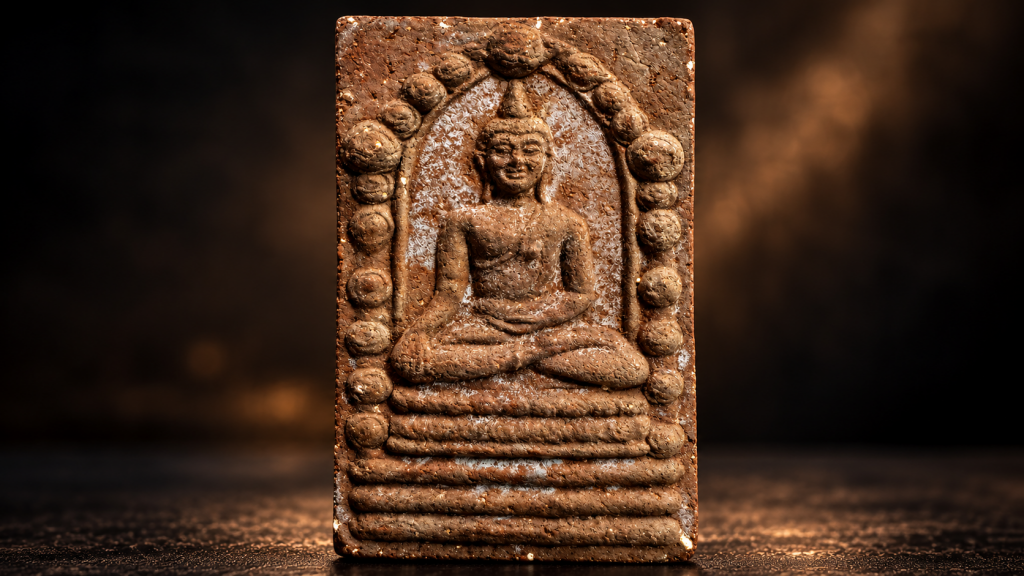
Phra Buddha Sihing, 1987
The Buddhist Image Created Alongside
the Suriyan–Chantra Amulets of Nakhon Si Thammarat
In the history of sacred objects associated with Nakhon Si Thammarat, the year 1987 (B.E. 2530) stands as a particularly significant moment. It was a period when the construction of the Nakhon Si Thammarat City Pillar Shrine was taking shape, together with a complex network of rituals, symbols, local beliefs, sacred materials, and narratives that would later become closely associated with what Thailand came to know as Chatukarm Ramathep.
Today, when collectors speak of sacred objects from 1987, one name usually comes first: the famous Suriyan–Chantra powder amulet, often referred to by collectors as the round “solar–lunar” amulet. In later decades, this amulet would become one of the most important early objects associated with the Chatukarm Ramathep tradition. Yet another sacred object was created at approximately the same historical moment. It was rectangular rather than circular. Its central image was not a deity surrounded by cosmic symbols, but the Buddha himself. It was the Phra Buddha Sihing amulet, Nakhon Si Thammarat City Pillar edition, B.E. 2530 (1987). For a time, this small Buddhist image may even have been more familiar to ordinary worshippers than the Suriyan–Chantra amulet that would later become legendary.
Phra Buddha Sihing: A Sacred Image of Nakhon Si Thammarat
The choice of Phra Buddha Sihing as the principal image was highly significant. Phra Buddha Sihing has long been associated with the religious and cultural history of Nakhon Si Thammarat. It represents not simply a Buddhist image, but an important element of the city’s religious identity. Creating a portable amulet based upon Phra Buddha Sihing during the establishment of the City Pillar therefore connected the new sacred project directly to an established Buddhist symbol familiar to the people of Nakhon Si Thammarat. Sources within the Thai amulet community state that the design was associated with Pol. Lt. Gen. Sanphet Thammathikun, while the mould engraving was carried out by Ajarn Montri Chanthaphan, both of whom were connected with the City Pillar sacred-object project of that period. The amulet therefore belongs not to a later commercial era of Jatukam Ramathep popularity, but to the formative period from which the tradition itself emerged.
One Side Buddhist, the Other Cosmic
The 1987 Phra Buddha Sihing was produced as a rectangular pressed-powder amulet. At its centre sits the Buddha in the Maravijaya posture, the gesture symbolizing the Buddha’s victory over Mara and the overcoming of obstacles on the path toward enlightenment. The seated image is surrounded by an ornamental arch featuring spiral-like motifs, sometimes described by collectors as resembling “navels of the sea.” Some records describe approximately twenty-one spiral motifs of different sizes surrounding the Buddha. The lower portion rests upon a multi-tiered base. Viewed only from the front, the object appears to be a conventional Buddhist devotional image. But the reverse reveals something very different. There appears the image of Rahu consuming the Sun and Moon. Beneath it are sacred diagrams and yantra-like symbols that collectors and traditional accounts associate with elemental formulas, protective inscriptions, and ritual knowledge. It is here that the direct visual relationship between Phra Buddha Sihing and the Suriyan–Chantra amulet becomes unmistakable. Symbolically, the amulet can therefore be read as containing two worlds:
The front represents the Buddha.
The reverse represents the cosmos.
On one side is the stillness of enlightenment.
On the other are the Sun, Moon, Rahu, elemental forces, sacred diagrams, and cosmological symbolism.
In a single small object, Buddhist faith and the traditional cosmology of southern Thailand appear side by side.
Created Alongside the Suriyan–Chantra Amulet
One of the most important facts concerning this edition is that Phra Buddha Sihing was not created decades after Chatukarm Ramathep became famous. It belongs to the early City Pillar period itself. Historical accounts within the amulet tradition consistently associate the Buddha Sihing amulets with the same period as the 1987 Suriyan–Chantra sacred objects. They were connected with the same City Pillar project, shared major components of the same sacred-material tradition, and were associated with the same broader ritual environment. Some records connect the amulets with the City Pillar eye-opening or consecration ceremonies held around 3–5 March 1987. This distinction is crucial. Phra Buddha Sihing is therefore not simply “a Chatukarm-related amulet.” It is a surviving object from the historical environment in which the earliest Suriyan–Chantra tradition itself was taking shape.
Sacred Materials: The Heart of the 1987 Amulet
Among the most fascinating aspects of the 1987 Phra Buddha Sihing is its muan san, or sacred material composition. Accounts preserved within the amulet tradition state that its principal sacred materials came from the same broad group used in the creation of the 1987 Suriyan–Chantra powder amulets. Recorded materials include:
Takian Thong wood associated with the City Pillar
Shell lime
Stone-derived lime or mineral powder
Earth from the Four Buddhist Holy Places
Earth collected from seven cemeteries
Minerals from seven mines
Cooked rice from seven rice fields
Powder from a naturally single-eyed coconut shell
Pollen and flower material from 108 varieties
108 auspicious medicinal or sacred herbs
Cane sugar
Royal or natural honey
Banana
Salt
Diamond-related mineral powder or traditional “ap phet” material
Sacred water from four sources or wells
Itthije sacred inscription powder
Sandalwood oil
as well as materials associated with the auspicious metals:
silver, gold, and nak — the traditional Thai gold-copper alloy.
These lists survive largely through documentation and accounts circulated within the amulet tradition. They should therefore be treated as historical records of the makers’ sacred-material tradition rather than as laboratory-confirmed chemical analyses of every surviving amulet. Nevertheless, culturally they are extremely important. They reveal the philosophy behind the creation. The makers were not attempting merely to manufacture a piece of pressed powder. They were attempting to gather symbolic materials from different aspects of the natural, religious, and ritual worlds and unite them within a single sacred object.
Takian Thong: The Material Linking the Amulet to the City Pillar
Among all the materials associated with the amulet, Takian Thong wood is arguably the most historically important. Takian wood has long played an important role in Thai beliefs surrounding major timber structures, sacred trees, and city-pillar traditions. In the context of Nakhon Si Thammarat, material associated with the City Pillar gave the amulets a physical connection to the larger City Pillar project. Some dark-coloured examples of the 1987 Phra Buddha Sihing are described by collectors as containing charcoal or powdered Takian wood, produced by burning and grinding the wood before mixing it into the amulet material. This has been used to explain the range of colours found among surviving examples:
deep black,
grey-black,
brownish black,
and, in some pieces, textures resembling fine organic fibres. Other examples occur in lighter shades, including white, cream, pale orange, and greenish-white, possibly resulting from differences in the proportion of lime, powder, charcoal, and organic ingredients used in individual batches. Symbolically, the incorporation of City Pillar-related Takian material transformed the amulet from a simple souvenir of the project into something more intimate. A small portion of the material world surrounding the City Pillar could, in principle, travel with the person who carried the amulet.
Earth from Seven Cemeteries, Minerals from Seven Mines, Rice from Seven Fields
Another remarkable group of ingredients traditionally recorded consists of:
earth from seven cemeteries,
minerals from seven mines,
and cooked rice from seven rice fields.
The number seven appears frequently in Thai ritual traditions and folk cosmology. Here, the three materials may be understood symbolically. Earth represents the ground upon which human life exists. Minerals represent hidden resources beneath the earth. Rice represents nourishment, fertility, cultivation, and survival. Together they form an extraordinary miniature representation of the lived landscape: the earth beneath human beings, the resources concealed within it, and the food grown upon its surface. Within the logic of ritual material culture, the amulet becomes a meeting place between the human world and the natural world.
108 Flowers and 108 Sacred Herbs
Traditional accounts also refer to: pollen or flowers from 108 varieties and 108 auspicious herbs. The number 108 occupies an important position in Buddhist, Hindu, and broader Asian religious culture. It frequently expresses ideas of completeness, totality, sacred order, and cosmological wholeness. Thus, the phrase “108 herbs” should not be understood merely as an inventory of plants. It is also a ritual language. The number communicates the intention to gather a complete or comprehensive collection of auspicious natural substances according to the worldview of the makers.
Sacred Water, Itthije Powder, and Sandalwood Oil
Another group of materials belongs more directly to ritual practice. These include:
sacred water from four sources,
Itthije powder,
and sandalwood oil.
Itthije powder belongs to an old Thai esoteric tradition in which sacred scripts and formulas are repeatedly written, recited, and erased, with the resulting powder preserved for use in sacred objects. Sandalwood, meanwhile, has been deeply embedded in Buddhist and royal ceremonial traditions across South and Southeast Asia. These substances therefore carried significance not simply because of their physical composition, but because of the ritual processes and cultural meanings attached to them.
Silver, Gold, and Nak
Traditional material lists also mention: silver, gold, and nak. These three metals have long held special status in Thai sacred art, jewellery, royal objects, and ritual craftsmanship. Here, however, an important distinction must be made. The 1987 Phra Buddha Sihing discussed in this article is fundamentally a pressed-powder amulet. The references to silver, gold, and nak concern materials said to have been included in the sacred-material preparation or broader consecration process. They do not mean that the standard amulet itself was cast entirely from precious metal. This distinction matters, especially when documenting the amulet historically.
The Ritual of the “Three Realms”
Among the most evocative stories associated with the 1987 sacred-object project is the account of consecrating or preparing materials in three different geographical environments. Traditional amulet histories describe rituals associated with:
the open sea,
Khao Khun Phanom mountain,
and
rice-field country.
Within the symbolic language of the tradition, these locations came to represent different realms of the natural world.
Water.
Earth.
Sky and elevated land.
The ritual is therefore often interpreted as an attempt to connect sacred materials with the wider natural universe before they were transformed into amulets. Some traditional accounts also refer to masters connected with the Wat Khao Or esoteric lineage of southern Thailand participating in chanting or ritual activities related to the project. These accounts are culturally important, but they should be presented for what they are:
ritual histories preserved within the sacred-object tradition.
They should not be interpreted as scientific claims that geographic locations physically altered the materials through supernatural energy. Their importance lies in what they reveal about the worldview of the people who created and revered the objects.
Many Moulds, One Edition
Another important characteristic of the 1987 Phra Buddha Sihing is the large number of mould variations. Because substantial quantities were produced, multiple moulds were necessary. As a result, small differences are found from one example to another. Collectors commonly classify the Buddha’s ushnisha or upper head detail into forms such as:
lotus-bud finial,
pointed finial,
and
elongated finial reaching toward the arch.
Some moulds contain additional fine anatomical details, while others do not. Variations are also found on the reverse. Collectors commonly distinguish between a more elaborately ornamented Rahu wearing regalia and simpler Rahu designs. These differences are significant for study. But they also create a danger. No single tiny detail should be used in isolation to declare an amulet authentic or false. A serious examination must consider mould characteristics, material, surface ageing, dimensions, production traces, provenance, and comparison with documented examples.
When Suriyan–Chantra Was Not Yet Famous
Imagine returning to Nakhon Si Thammarat in 1987. Two sacred objects lie before you. One depicts the Buddha. The other is a strange circular object covered with symbols of Rahu, the Sun, Moon, zodiac, and cosmic diagrams. Which would an ordinary Buddhist family choose? At the time, the answer may well have been the Buddha Sihing. The cultural meaning of the image was immediately understood. The symbolic language of Suriyan–Chantra, however, had not yet acquired the national recognition it would gain in later years. Over time, that situation changed dramatically. Stories surrounding Chatukarm Ramathep spread. The Suriyan–Chantra amulet became increasingly valued. By the middle of the 2000s, Jatukam Ramathep had become a nationwide phenomenon. What had once been unfamiliar became legendary. And the Buddha Sihing amulet that had stood beside it from the beginning gradually moved into the background of popular memory.
A Forgotten Amulet — or an Overlooked Historical Witness?
If value is measured only by market price and collector demand, Phra Buddha Sihing may appear secondary to the famous Suriyan–Chantra amulets. Historically, however, the situation is far more interesting. The Buddha Sihing amulet: was created in the City Pillar period, belongs to the same historical environment as Suriyan–Chantra, was made using materials from the same broad sacred-material tradition, carries Rahu, Sun, and Moon imagery on its reverse, and was associated with the ritual world from which early Jatukam Ramathep history emerged. Therefore, anyone attempting to understand the origins of Jatukam Ramathep by studying only Suriyan–Chantra is looking at only part of the story. Phra Buddha Sihing belongs in that history as well.
The Buddha and the Cosmos in One Object
Perhaps the deepest significance of the 1987 Phra Buddha Sihing lies not in rarity or market classification, but in its visual language. On the front is the Buddha. On the reverse is Rahu consuming the Sun and Moon. The Buddha represents awakening and Dharma. The Sun and Moon belong to the celestial order. Rahu belongs to an ancient cosmology of eclipses and planetary forces. The material body of the amulet incorporates earth, plants, minerals, water, wood, ritual powders, and precious metals. Everything meets within a single object only a few centimetres in size. This makes the amulet an extraordinary example of the religious world of southern Thailand, where Buddhism, local beliefs, astrology, ritual knowledge, sacred geography, and the memory of the city could exist together rather than as separate systems.
More Than an Amulet: A Time Capsule from 1987
Nearly four decades later, the historical importance of the 1987 Phra Buddha Sihing lies not merely in its age. The amulet can be read as a time capsule. Takian wood recalls the City Pillar. Earth recalls the land. Rice recalls everyday life and agriculture. Herbs and flowers recall traditional knowledge of nature. Sacred water and Itthije powder recall ritual practice. Rahu, the Sun, and the Moon recall an ancient cosmic worldview. And the Buddha Sihing on the front reminds us that, at the centre of the entire object, remains a Buddhist sacred image. Together, these elements transform the amulet into something more than an object worn around the neck. It becomes evidence of a moment in history. A moment when the Nakhon Si Thammarat City Pillar tradition was taking shape. A moment when Suriyan–Chantra had not yet become legendary. And a moment when the name Jatukam Ramathep was not yet known throughout Thailand.
Epilogue: The Image That Stood Beside the Legend from the Beginning
Today, when collectors speak of sacred objects from 1987, the Suriyan–Chantra amulet often receives the greatest attention. That attention is understandable. Suriyan–Chantra played a central role in the development and later expansion of Chatukarm Ramathep belief. But anyone seeking to understand the complete history should not allow Phra Buddha Sihing to disappear from the narrative. The 1987 Phra Buddha Sihing did not arrive after Chatukarm Ramathep became famous.
It was there from the beginning. It was there during the City Pillar period. It shared the same sacred-material world. It carried the imagery of the Sun, Moon, and Rahu. It belonged to the same ritual landscape. And it survived as a quiet witness to the birth of a tradition that would eventually become one of the most remarkable sacred-object phenomena in modern Thai history. If the 1987 Suriyan–Chantra amulet is one of the doors through which we enter the early history of Jatukam Ramathep, then the 1987 Phra Buddha Sihing is the silent witness that has stood beside that door since the very first day.

Recommended for you